Safety factor for cantilever beam
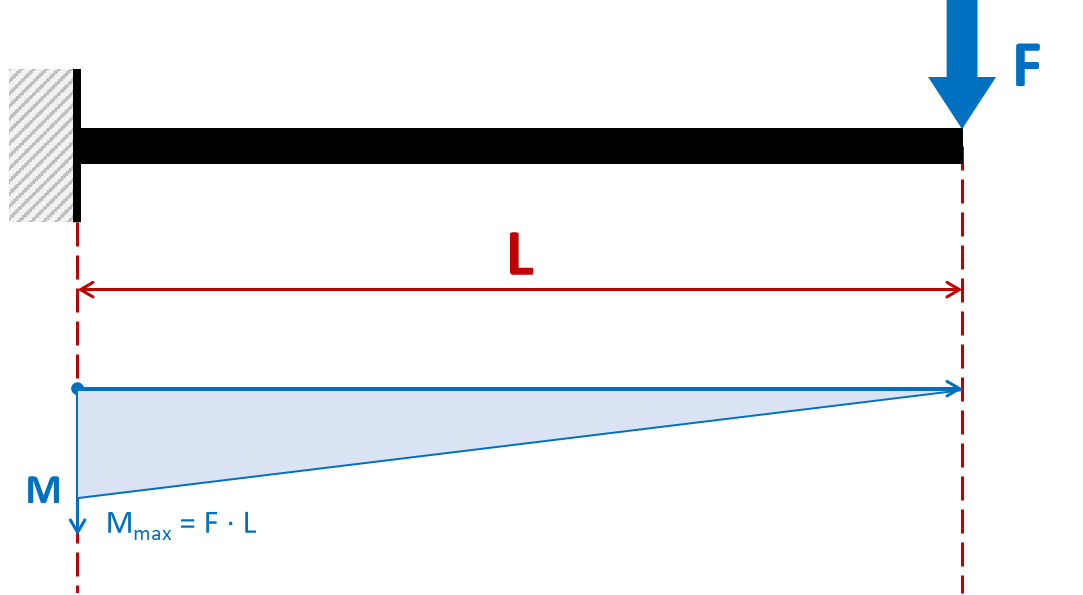
Calculate the safety factor for a cantileved beam with rectangular cross section and a punctual force acting on its free extreme
Answer
The safety factor can be calculated as the relation between the maximum acceptable stress for the part to perform divided by the maximum stress that the part will withstand during operation. For beans and ductile parts, the yield strength \(\sigma_y\) is taken as the maximum acceptable stress, so:
$$SF = \frac{\text{max acceptable stress}}{\text{max real stress}} = \frac{\sigma_y}{\sigma_{max}}$$
Method 1
We need to calculate the maximum real stress \(\sigma_{max}\) as a function of the data provided:
- First need to calculate the second moment of area (inertia moment), for a beam with rectangular section will be: \(I_y=\int_{A} z^2 \,dA = \frac{W \cdot H^3}{12}\)
- The biggest stresses will be located in the fixed extreme of the beam, where the flexural momentum in that section is: \(M = F \cdot L\)
- Now, we need to find the relation between \(M\) and the stress \(\sigma\), to do so:
- It is known that the deformation inside the section will follow a linear evolution going from the maximum compression at the bottom fiber, to maximum extension at the top fiber: \(\epsilon_x = -\frac{z}{c} \cdot \epsilon_{max}\) where \(c\) is the distance from the neutral fiber to the maximum stress fiber, usually: \(c=H/2\)
- According to the Hooke law, if both sides of the last equation are multiplied by \(E\), we will get stresses: \(E \cdot \epsilon_x =-\frac{z}{c} \cdot E \cdot \epsilon_{max} \rightarrow \sigma_x = -\frac{z}{c} \cdot \sigma_{max}\)
- Also, we know that a differential force can be written as the product of the normal stress it generates over a differential section of the area: \(dF = \sigma_x \cdot dA\)
- Now we know that the flexural moment can be calculated as the force applied at a certain distance, so: \(dM = z \cdot dF\), so, introducing equation from (3): \(dM = z \cdot \sigma_x \cdot dA\) and then introducing (2): \(dM = z \cdot \sigma_x \cdot dA = - \frac{z^2}{c} \cdot \sigma_{max} \cdot dA\)
- Integrating this last equation: \(M = \frac{\sigma_{max}}{c} \cdot \int_{A} z^2 \,dA = \frac{\sigma_{max}}{c} \cdot I_y \)
- So, the maximum stress can be extracted form this last equation: \(\sigma_{max} = \frac{M \cdot c}{I_y} = \frac{M \cdot H}{2 \cdot I_y} = \frac{F \cdot L \cdot H}{2 \cdot I_y} = \frac{F \cdot L \cdot H}{2 \cdot \frac{WH^3}{12}} = \frac{6 \cdot F \cdot L}{W \cdot H^2}\)
So, the safety factor will be: \(SF = \frac{\sigma_y}{\frac{6 \cdot F \cdot L}{W \cdot H^2}} = \frac{\sigma_y \cdot W \cdot H^2}{6 \cdot F \cdot L}\)
Method 2
Another way to calculate the maximum real stress \(\sigma_{max}\) can be to remember that the normal stresses due to axial and flexural forces is given by:
$$\sigma_x(y,z) = \frac{N_x}{A} + \frac{M_y}{I_y} \cdot z - \frac{M_z}{I_z} \cdot y$$
And, as we only have flexural moment in one direction and no axial forces, the resulting equation is:
$$\sigma_x(y,z) = \frac{M_y}{I_y} \cdot z$$
Now, we only need to find the variables from the right side of that equation:
- As the cross section of the beam is constant, the second moment of area (inertia moment) will also be constant, and for rectangular section has a value of: \(I_y=\int_{A} z^2 \,dA = \frac{W \cdot H^3}{12}\)
- If \(I_y\) is constant, the stress will be maximum when the flexural moment is maximum. And this happens in the fixed extreme of the beam, where the flexural moment has a value of: \(M = F \cdot L\)
- Then, the maximum stress will happen in the top fiber of the beam, that is: \(z=H/2\):
So, putting all this in the previous equation:
$$\sigma_{max} = \frac{F \cdot L \cdot H}{2\cdot I_y} = \frac{F \cdot L \cdot H}{2\cdot \frac{W \cdot H^3}{12}} = \frac{6 \cdot F \cdot L}{W \cdot H^2}$$
And again, the safety factor will be:
$$SF = \frac{\sigma_y}{\frac{6 \cdot F \cdot L}{W \cdot H^2}} = \frac{\sigma_y \cdot W \cdot H^2}{6 \cdot F \cdot L}$$