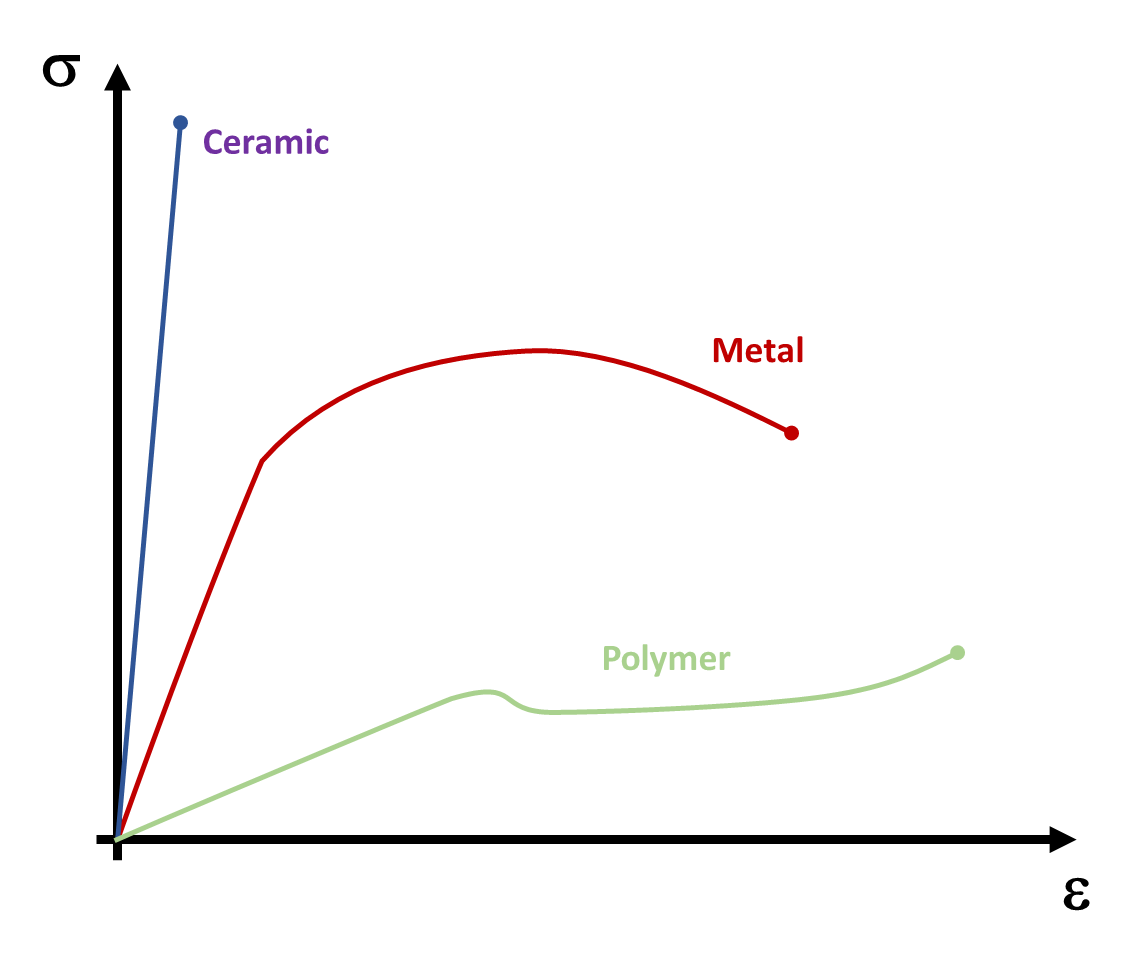
Stress-strain curve for metallic, ceramic and polymar materials
Draw the stress-strain curve for a metallic, a ceramic and a polymer materials
Answer
There are three main parameters that define a stress-strain curve: the young modulus, the yield strength and the ultimate tensile strength. Let´s see what each of these parameteres mean, and how do they compare for metals, ceramic materials and polymers:
- Young modulus \((E)\): it is the tensile stiffness of a solid material when a force is applied lengthwise, and corresponds to the slope of the curve in the elastic region.
$$E_{Ceramic} > E_{Metal} > E_{Polymer}$$
- Yield strength \((\sigma_Y)\): it is the stress at which the material starts to exhibit a certain amount of permanent deformation, usually taken as the elastic limit.
$$\sigma_{Y-Ceramic} > \sigma_{Y-Metal} > \sigma_{Y-Polymer}$$
- Ultimate tensile strength \((UTL)\): it is is the maximum stress that a material can withstand before breaking.
$$UTL_{Ceramic} > UTL_{Metal} > UTL_{Polymer}$$
Usually, ceramic materials are the strongest (bigger Young modulus), while polymers are the ones with greatest elongation before plastic deformation takes place. The stress-strain curves for these three type of materials would compare as follows: