Discharge velocity of deposit with hole
Which is the discharge velocity of a deposit of water (height \(H\) and diameter \(D\)) with a hole on the bottom of the lateral wall.
Answer
This is the typical question that can be solved by using Bernoulli equation between two points. So, let's start by stating that point 1 will be exactly at the water top surface (in the deposit), while point 2 will be at the discharge surface in the bottom.
$$P_1 + \frac{\rho}{2} \cdot V_1^2 + \rho \cdot g \cdot h_1 = P_2 + \frac{\rho}{2} \cdot V_2^2 + \rho \cdot g \cdot h_2$$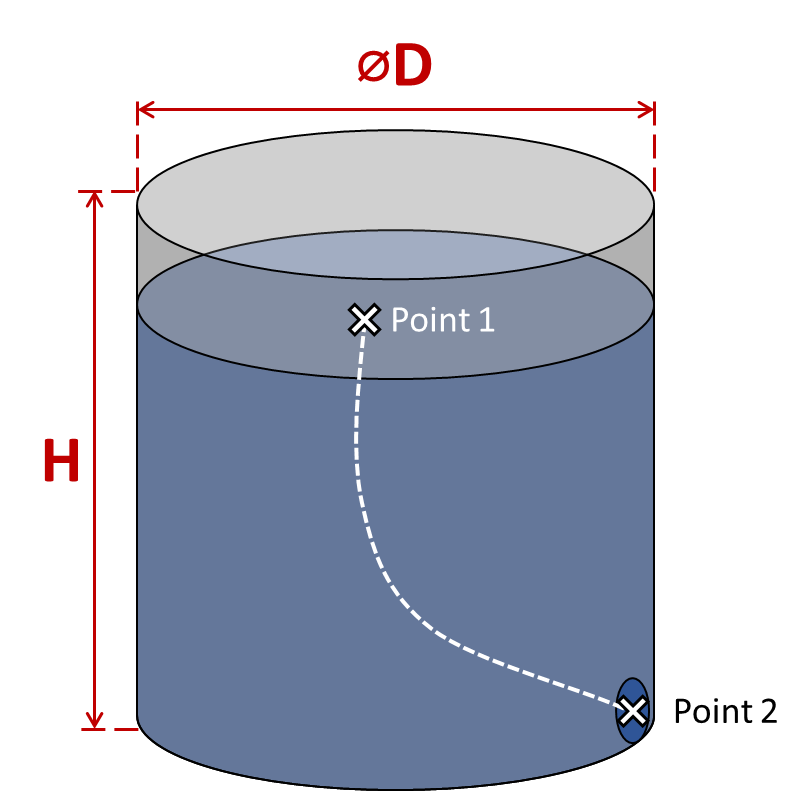
When we apply Bernoulli in this kind of systems, it is common that we can simplify some of the variables:
- If the deposit is open to the atmosphere, then the pressure at both points is the atmospheric pressure: \(P_1 = P_2\)
- If the deposit diameter is much bigger than the hole diameter (\(D \gg d\)), then \(V_1 \approx 0\), so the term \(\frac{\rho}{2} \cdot V_1^2\) can be neglected
- We will choose that the origin in the vertical direction is right at the center of the hole, so \(h_2 = 0\) and \(h_1 = H\)
Introducing these simplifications in the equation, we are left with only two members, with only one unknown, which is the discharge velocity:
$$\cancel{P_1} + \cancel{\frac{\rho}{2} \cdot V_1^2} + \rho \cdot g \cdot h_1 = \cancel{P_2} + \frac{\rho}{2} \cdot V_2^2 + \cancel{\rho \cdot g \cdot h_2}$$ $$\rho \cdot g \cdot H = \frac{\rho}{2} \cdot V_2^2$$Solving the equation for \(V_2\):
$$V_2 = \sqrt{2\cdot g \cdot H}$$