True and traditional stress-strain curves
What's the difference between a true stress-strain curve and a traditional stress-strain curve?
Answer
Stress-strain curves have two regions, elastic and plastic regions. When a probe is under stress in the elastic region, it will return to its original form if the stress is removed. In contrast, in the plastic region, permanent deformation occurs. And, this permanent deformation causes "necking" in the probe, which is basically a reduction in the cross section area.
As the stress is force divided by the cross-section, the stress will increase for a given force when necking occurs. The more traditional stress-strain curve doesn't accounts for this area reduction, but the true stress-strain curve does take this in consideration the real area at every moment. Resulting into both curves being same in the elastic region, but different in the plastic region.
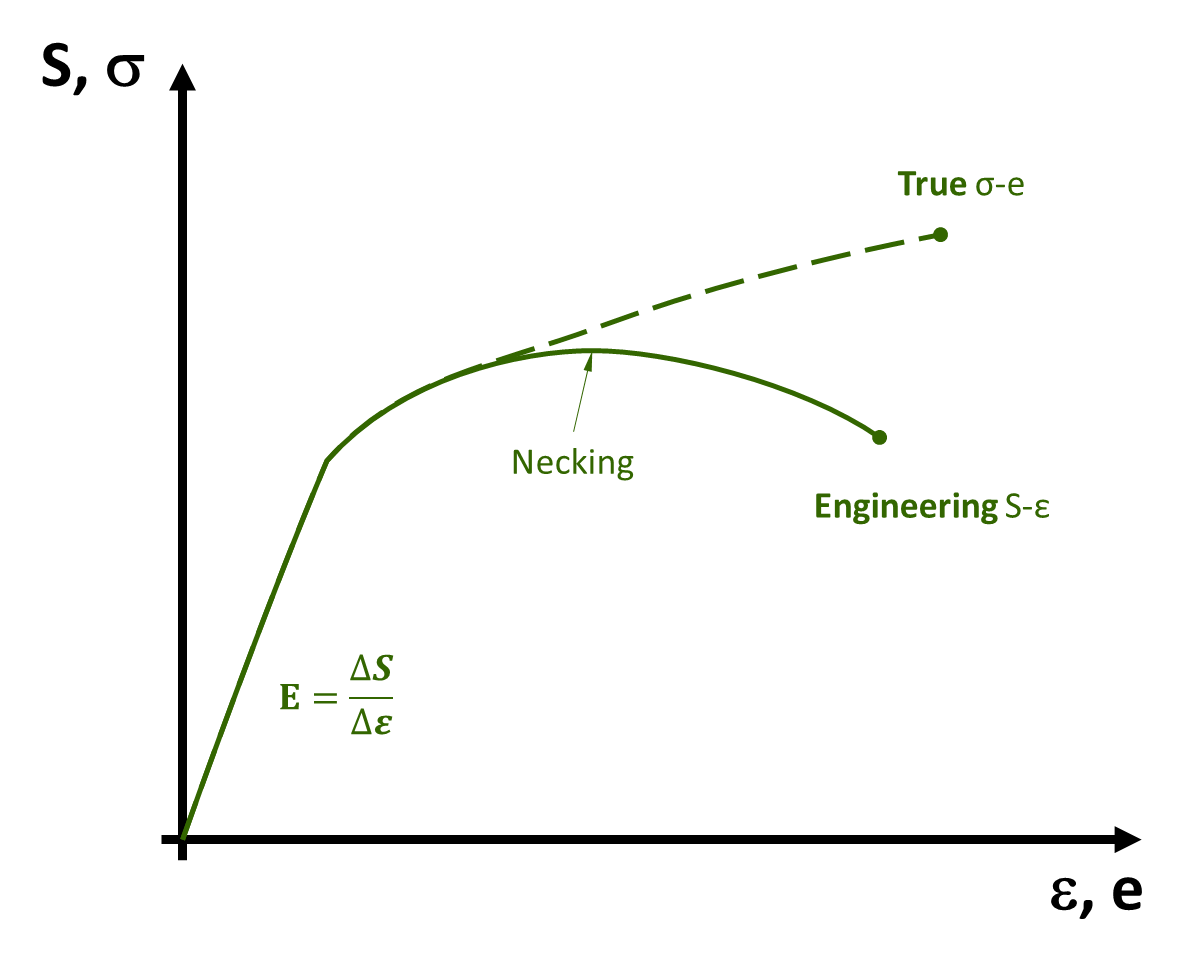
Another way of understanding this is that the engineering (or traditional) stress-strain curve shows a decrease in the stress after necking because the probe is getting weaker as it is stretched. In contrast, the true curve will show an increase in the stress because the material is getting stronger as it is stretched.